
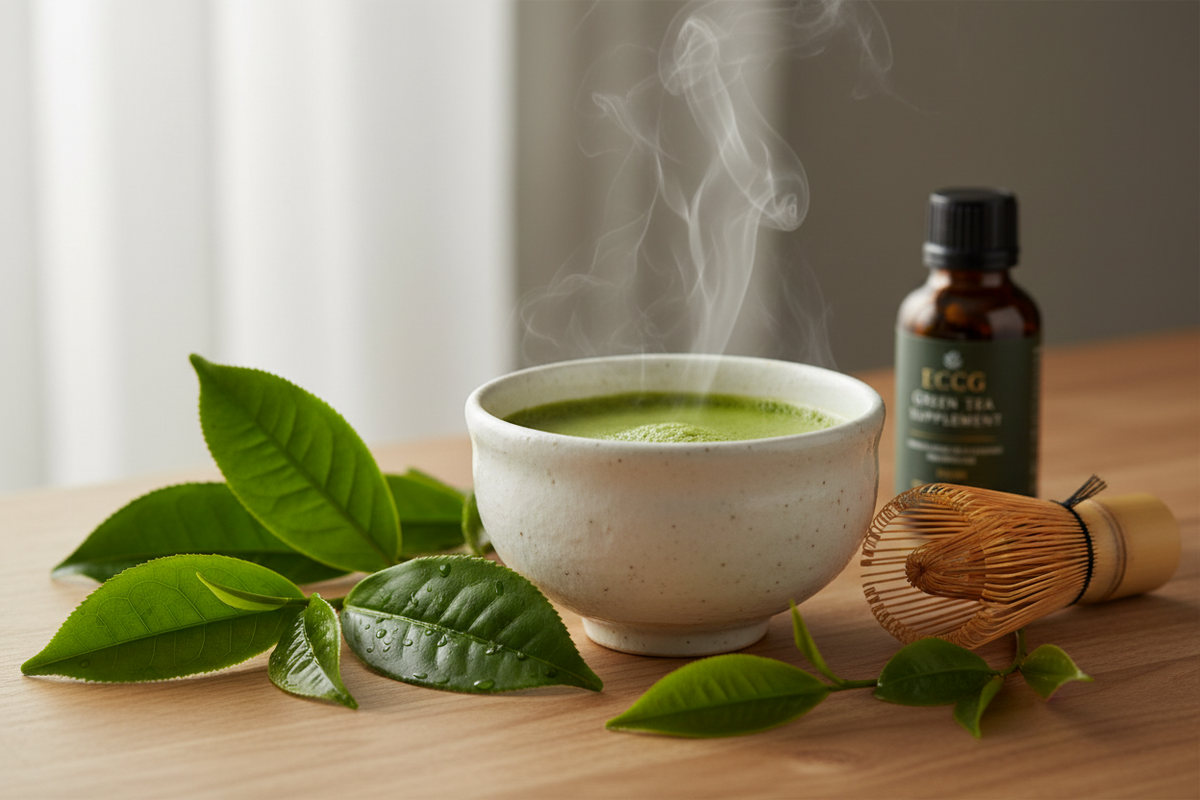
What Is EGCG? The Science Behind Green Tea's Most Studied Compound
If you've spent any time reading about green tea, you've probably run into the term EGCG. It shows up on supplement labels, in nutrition articles, and in more scientific literature than almost any other plant compound. But what actually is it, and why does it matter?
EGCG, in plain terms
EGCG stands for epigallocatechin gallate. It belongs to a family of plant compounds called catechins, which are themselves part of the larger polyphenol group — the same category of antioxidants found in berries, dark chocolate, and red wine. Among green tea's catechins, EGCG is both the most abundant and the most studied.
Green tea leaves are unique in how they're processed: unlike black tea, they aren't oxidized during production. That's what preserves their high catechin content, and EGCG in particular.
Why concentration is the real challenge
Here's the catch: a single cup of brewed green tea contains a relatively modest, and highly variable, amount of EGCG — depending on the tea, the water temperature, and how long it steeps. Researchers studying EGCG's effects typically work with doses that would require drinking several cups a day, consistently, to match.
That's the practical problem a concentrated green tea extract is trying to solve: giving you a standardized, measurable amount of EGCG instead of an estimate.
The bioavailability problem
Having EGCG in front of you and actually absorbing it are two different things. On its own, EGCG has relatively low bioavailability — much of it breaks down in the digestive process before your body can use it.
This is why formulation matters as much as concentration. Two ingredients are commonly paired with green tea extract to help with this:
- Piperine (black pepper extract) — studied for its ability to improve the absorption of various plant compounds.
- Vitamin C — helps stabilize catechins once they're in the body, since EGCG is sensitive to oxidation.
A green tea extract without attention to bioavailability may look impressive on the label but deliver far less than the number suggests.
How tigovit approaches this
tigovit is built around this exact challenge: a concentrated green tea extract combined with piperine and vitamin C, sourced from water-based extraction rather than chemical solvents. The goal isn't the highest possible number on the label — it's a formula designed so your body can actually make use of what's in the capsule.
If you're comparing green tea extracts, the questions worth asking aren't just "how much EGCG" but "extracted how" and "absorbed how."

The takeaway
EGCG is one of the best-researched plant compounds there is, but raw concentration only tells half the story. Extraction method and bioavailability determine whether that number on the label actually reaches your body.
This article is for general educational purposes and is not medical advice. Dietary supplements are not intended to diagnose, treat, cure, or prevent any disease.
Share:
In Search of the Right Green Tea Extract: The Story Behind tigovit
Matcha vs. Green Tea Extract: Which One Fits Your Day?